Tailor Your CV to the Job Description: A Step-by-Step Guide
Learn how to tailor your CV to each job and clearly show recruiters why you’re a strong match.
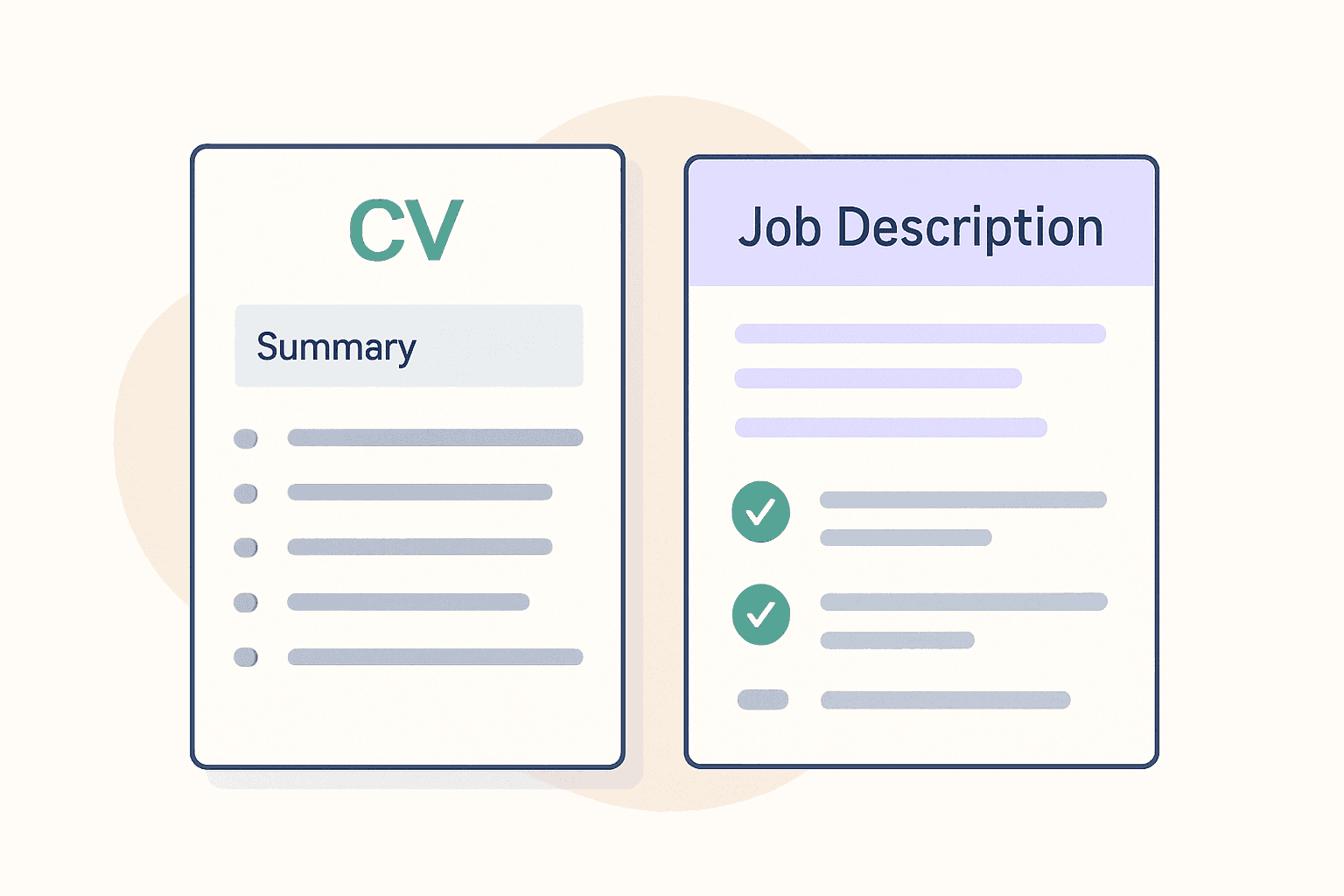
A tailored CV highlights the experience that matters most for each role.
Applying for jobs with the same CV every time is one of the most common reasons applications get ignored.
Recruiters can spot a generic CV in seconds, and applicant tracking systems (ATS) are designed to filter out CVs that don’t clearly match the job description. Even highly qualified candidates get rejected simply because their CV isn’t tailored to the role.
This guide shows you how to tailor your CV to any job, whether you’re a graduate, changing careers, or applying for more senior roles.
Whether you call it a CV or a Resume, the rules for tailoring are the same.
You’ll learn how to:
- identify the most important keywords in a job description
- tailor your experience without exaggerating or rewriting everything
- update your summary and skills section for each application
- keep your CV professional, readable, and ATS-friendly
If you want to skip the manual work, you can automatically tailor your CV using our tool here:
tailor your CV
Why Tailoring Your CV Matters
Most employers receive dozens, and often hundreds, of applications for a single role. Because of this volume, recruiters rarely read CVs line by line.
Instead, they scan quickly for signals that answer one question: “Is this person a good match for this role?”
When recruiters review CVs, they look for:
- clear alignment with the job description
- relevant skills and experience
- familiar terminology and tools that match the job
- evidence that you’ve read the role properly
If those signals aren’t obvious within the first few seconds, the CV is often set aside, even if the candidate is qualified.
Applicant tracking systems (ATS) make this even harder. Many companies use ATS software to automatically filter or rank CVs based on how closely they match the job description. CVs that use generic language or lack relevant keywords may never reach a human reviewer.
A tailored CV solves both problems. It highlights the most relevant experience, uses language the employer recognises, and makes it immediately clear why you’re a good fit. This makes it much easier for recruiters to understand your profile and increases the chances of your application being taken seriously.
A generic CV, by contrast, often blends into the pile, not because it’s bad, but because it doesn’t clearly answer the employer’s needs.
What Does “Tailoring a CV” Actually Mean?
Tailoring your CV does not mean:
- lying or exaggerating your experience
- rewriting your entire work history for every application
- inventing skills you don’t have
- changing your career story each time you apply
Many people avoid tailoring because they think it requires a complete rewrite or feels dishonest. In reality, effective CV tailoring is much simpler and entirely legitimate.
Tailoring your CV does mean:
- adjusting your language to match the role you’re applying for
- emphasising experience that’s most relevant to the job
- aligning your summary and skills section with the job description
- removing or de-emphasising details that aren’t important for that role
It comes down to relevance. Employers don’t need to see everything you’ve ever done, they need to quickly understand why your experience fits this role.
You’re presenting the same experience, just framed in a way that matches the employer’s priorities.
How to Tailor Your CV in 5 Simple Steps
1. Read the Job Description Properly
Before editing anything, read the job description carefully. Job descriptions are not just descriptions, they’re a checklist of what the employer cares about most.
Pay attention to:
- key responsibilities
- required skills and tools
- repeated phrases or terminology
- seniority level and expectations
Anything that appears more than once is usually a priority. These are the areas your CV should reflect most clearly.
2. Match Your Experience to the Job’s Language
Once you understand what the role is asking for, look at how responsibilities and tools are described, then mirror that language in your CV where it’s truthful.
This doesn’t mean copying the job description word for word. It means using familiar terms that make your experience easier to recognise.
Example:
- “Worked on customer issues” → “Resolved customer support tickets using Zendesk”
- “Built features” → “Developed React features for a customer-facing web application”
Using the employer’s language helps both recruiters and ATS systems quickly understand your relevance.
3. Rewrite Your Experience Bullet Points
Your experience section is where tailoring has the biggest impact.
Focus on:
- one clear achievement per bullet
- action-oriented language
- outcomes or results where possible
A simple structure works well:
Action + responsibility + outcome
Before
- Responsible for managing tasks and working with a team.
After
- Managed cross-functional tasks with a team of 5, delivering projects on schedule.
This makes your contribution clearer and more convincing.
Tip: If you don’t know exact metrics, focus on scope, responsibility, or technical impact rather than guessing numbers.
4. Update Your Profile / Summary
Your summary is often the first section a recruiter reads, so it should change for each role.
Avoid vague phrases like:
- “Hard-working professional”
- “Results-driven individual”
Instead, align your summary directly with the role you’re applying for.
Example:
Customer Support Specialist with 3+ years’ experience resolving high-volume support tickets and maintaining a 95% satisfaction rating.
A tailored summary tells the recruiter exactly what to expect from the rest of your CV.
5. Adjust Your Skills Section
Finally, review your skills list and tailor it to the job.
This usually means:
- prioritising skills mentioned in the job description
- removing or de-emphasising irrelevant ones
- keeping the list focused and realistic
A shorter, role-aligned skills section is easier to scan and performs better in ATS screening than a long, unfocused list.
Tailored vs Generic CV Examples
Below are simple examples showing how tailoring changes emphasis without changing experience.
Profile Example
Generic
Experienced professional with a strong background in various marketing roles.
Tailored
Marketing Executive with experience running paid social campaigns and analysing performance across Meta and Google Ads.
Experience Example
Generic
- Worked on software projects and collaborated with teams.
Tailored
- Built and maintained React components as part of an agile engineering team.
Skills Example
Generic
- Communication
- Teamwork
- Microsoft Office
Tailored
- Stakeholder communication
- Customer query resolution
- CRM systems (Salesforce)
- Process improvement
How ATS Systems Affect CV Tailoring
Many companies use applicant tracking systems (ATS) to manage and filter job applications before they reach a recruiter. These systems help employers handle large volumes of CVs by scanning, organising, and ranking applications based on relevance.
ATS software doesn’t reject CVs in a human sense. It looks for signals that indicate relevance to the role. CVs that are unclear, poorly structured, or use very generic language may be ranked lower or filtered out automatically.
To stay ATS-friendly, it’s best to:
- use standard section headings such as Experience, Work Experience, Skills, Education, and Projects
- avoid excessive graphics, icons, or tables that can confuse parsing
- keep formatting simple and consistent
- include relevant keywords naturally within your experience and skills
Tailoring your CV helps because it aligns your language with the job description. When your CV reflects the skills, tools, and responsibilities the employer is looking for, ATS systems are more likely to recognise it as a strong match.
Just as importantly, an ATS-friendly CV is also easier for recruiters to read once it reaches them. Clean structure and clear relevance benefit both automated screening and human review.
Templates That Work Well for Tailored CVs
Clean, simple templates work best when tailoring your CV. When applying for different roles, clarity and structure matter far more than visual decoration.
The most effective CV templates:
- use clear section headings and spacing
- prioritise readability over design flourishes
- keep layouts consistent and predictable
- avoid heavy graphics, icons, or complex columns
These qualities make it easier to adjust content for each job and help both ATS systems and recruiters quickly understand your experience.
You can start with:
- Pastel Creative CV Template, designed for professional roles that still benefit from a modern, approachable style
- other clean, ATS-friendly templates in our library
All of our templates are built to support tailoring. They’re easy to edit, business-appropriate, and structured to keep the focus on your experience rather than visual distractions.
Choosing the right template won’t replace tailoring, but it ensures your tailored content is presented clearly and professionally.
Save Time by Tailoring Your CV Automatically
Manually tailoring your CV for every application can take 30–60 minutes each time. When you’re applying to multiple roles, that effort adds up quickly.
CraftAI CV applies the same tailoring principles covered in this guide, but automates the time consuming parts. It helps by:
- structuring your existing CV into clear, editable sections
- analysing the job description for relevant skills and language
- rewriting experience bullets and summaries to match the role
- showing a live preview so you can review and edit before downloading
You stay in control of the final content, but save time on repetitive rewriting.
Try tailoring your CV automatically with CraftAI CV: tailor
Common Mistakes to Avoid When Tailoring Your CV
Even well-intentioned tailoring can hurt your application if it’s done poorly. Here are some common mistakes to avoid when tailoring your CV.
Copy-pasting job descriptions into your CV
Simply copying sections of the job description into your CV is one of the most obvious mistakes. Recruiters recognise this instantly, and ATS systems are often designed to penalise excessive duplication.
Instead, rewrite requirements in your own words and tie them directly to your experience. Tailoring should show understanding, not imitation.
Keyword stuffing
Including relevant keywords is important, but forcing them unnaturally into your CV can backfire. Overloaded skills sections or awkward sentences reduce readability and can make your CV feel inauthentic.
Keywords should appear naturally within your experience and skills, not as a checklist.
Keeping irrelevant experience unchanged
Not every role you’ve held is equally relevant to every job you apply for. Leaving unrelated experience unchanged can distract from your strongest qualifications.
When tailoring, prioritise experience that aligns with the role and reduce detail on less relevant positions rather than removing them entirely.
Using overly generic summaries
A generic summary wastes valuable space at the top of your CV. Phrases like “hard-working professional” don’t tell recruiters what you actually do or why you’re a good fit.
Your summary should reflect the role you’re applying for and set clear expectations for the rest of your CV.
Over-designing layouts
Complex layouts, heavy graphics, icons, and unusual formatting can cause problems for both ATS systems and recruiters. Over-designed CVs are harder to scan and can obscure important information.
Clean structure and clear headings will always outperform decorative design when tailoring your CV.
Making text too small to fit more content
Reducing font size or spacing to squeeze in more information often makes your CV difficult to read. If your CV feels crowded, it’s usually a sign that content needs prioritising, not shrinking.
Clarity and readability matter more than fitting everything onto a single page.
Quick CV Tailoring Checklist
Before submitting an application, take a moment to review your CV using this checklist. It helps ensure your CV is clear, relevant, and tailored to the role.
-
Does my summary match this role?
It should clearly state what you do and how your experience aligns with the job description. -
Do my top experience bullets reflect the job requirements?
The most important responsibilities and skills from the job description should be visible in your recent experience. -
Are my skills relevant and up to date?
Prioritise skills the employer is asking for and remove anything that isn’t relevant to this role. -
Is the formatting clean and readable?
Use clear headings, consistent spacing, and a readable font size. Avoid clutter. -
Would this CV make sense to a recruiter in 10 seconds?
A quick scan should clearly show why you’re a good fit for the role.
If you can confidently answer “yes” to each question, your CV is ready to submit.
Final Thoughts
Tailoring your CV doesn’t require rewriting everything from scratch. It requires intention and focus.
A well tailored CV shows recruiters that you understand the role, have read the job description carefully, and know how your experience fits their needs. That clarity can make the difference between being overlooked and being shortlisted.
If you want to save time while keeping your CV professional and ATS-friendly, you can tailor your CV automatically using CraftAI CV here:
Start tailoring your CV for free

Related articles
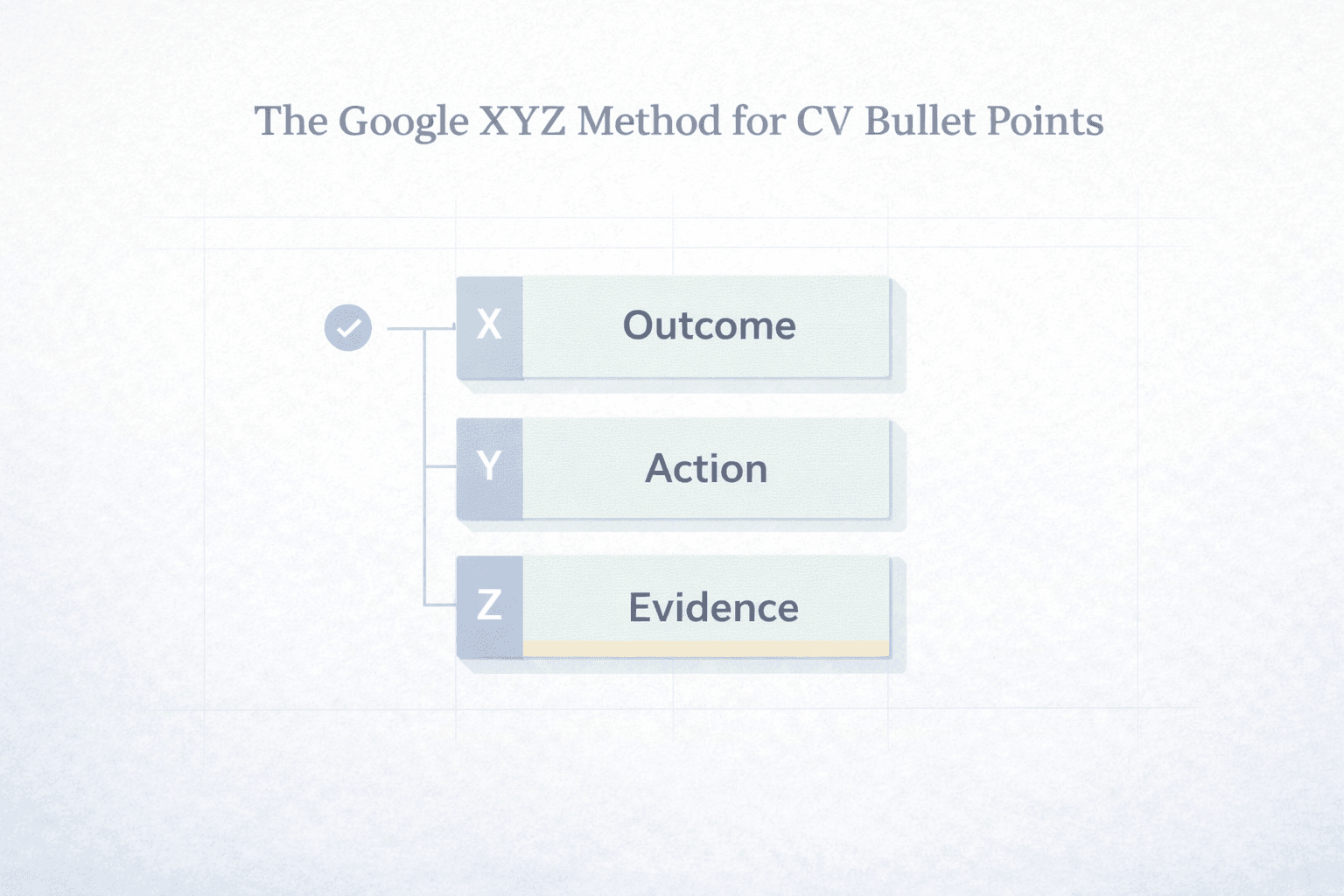
Google XYZ Resume Method: Write Bullets That Show Impact
A complete guide to the Google XYZ resume method: what it is, where it came from, and how to apply it across industries with examples, templates, and an FAQ.

How Long Should a CV Be? Why One Page Wins in 2026
Recruiters spend 7 seconds scanning your CV. Learn when a one-page CV works best, who should use two pages, and how to tailor yours for every role.

CV Not Getting Interviews? 7 Reasons and Quick Fixes
Qualified but hearing nothing back? See how recruiters and ATS actually screen CVs, plus simple changes that get more interview callbacks.